







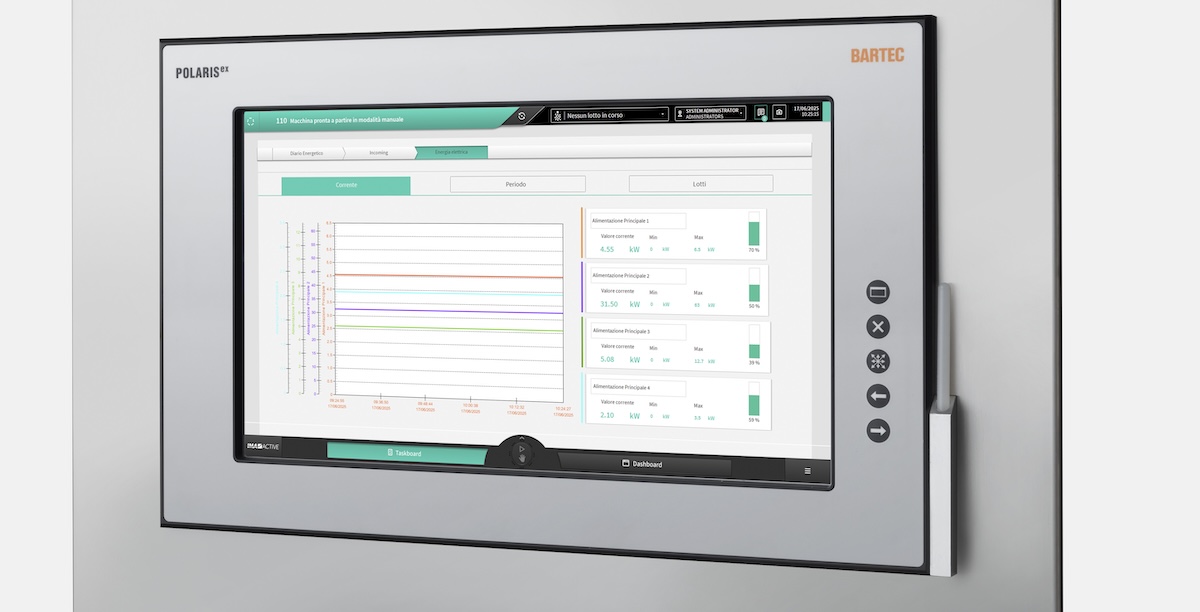
Sustainability is a collective journey rooted in our values, embedded in our technologies, and shaped together with all who move forward with us. In this shared path, IMA acts as a Sustainability Enabler, translating environmental and social challenges into measurable improvements in efficiency, transparency and responsible resource use across the value chain.
Our strategy is guided by four sustainability priorities, identified for their relevance to our business model and to the expectations of the industries we serve: Climate & Resources, People & Empowerment, Innovation & Product Responsibility, and Ethics, Governance & Transparency. To advance these priorities in a structured and measurable way, IMA has established four cross-cutting programmes within its DEEP approach: Decarbonising our value chain, Enabling circularity, Empowering people & communities, and Partnering for a responsible & resilient supply chain.
Within this framework, initiatives that enhance energy efficiency and data transparency play a tangible role in advancing Decarbonising our value chain and Enabling circularity, while supporting broader progress across multiple priorities.
The Energy Diary developed by IMA Active is a concrete expression of this approach. By enabling precise monitoring and analysis of machine energy consumption, it provides operators with the insights needed to optimise processes, reduce emissions and improve resource efficiency. In doing so, it contributes directly to the decarbonisation of industrial operations and to more circular, resource-efficient production models, demonstrating how strategic priorities are translated into practical, measurable solutions.
In line with this approach to more efficient and transparent energy management, IMA Active has developed the Energy Diary, a system created in the iFIX SCADA environment which allows energy consumption to be monitored and analysed both in real time and historically, providing a complete and detailed view of the machine's energy performance.

The system, designed to be an optional feature across all machine types, is implemented through the integration of sensors and interfaces to provide consumption reports even over the long term. The Energy Diary requires the addition of specific sensors, which constantly monitor the supplies used by a specific machine, or in other words, its points of use - defined based on customer requests and technical and environmental layouts. These include:
• electrical power;
• thermal energy (including steam and cold water consumption);
• pneumatic energy
The data recorded by side-line sensors are acquired by a separate data logger, integrated, however, into the automation, and transmitted to the HMI interface, which in turn delivers the data to a dedicated database, ensuring highly reliable information logging.
The Energy Diary complies with PackML, an acronym for Packaging Machine Language, the industry standard defined by Machine Control manufacturers for data packaging, which enables interaction among machines and guarantees functional interoperability and uniformity of the HMI interface. Through PackTags, it provides a standard method for transferring data, including energy data. The system is available in two versions, allowing for a progressively more detailed level of monitoring of the relevant machine consumption figures.
The basic version allows users to check and store consumption data for the main machine supplies. Each supply is reported using the appropriate engineering unit, ensuring accurate and consistent data.
By accessing the "Supplies" page, consumption data can be viewed in real time, with numerical and percent values, divided by category.
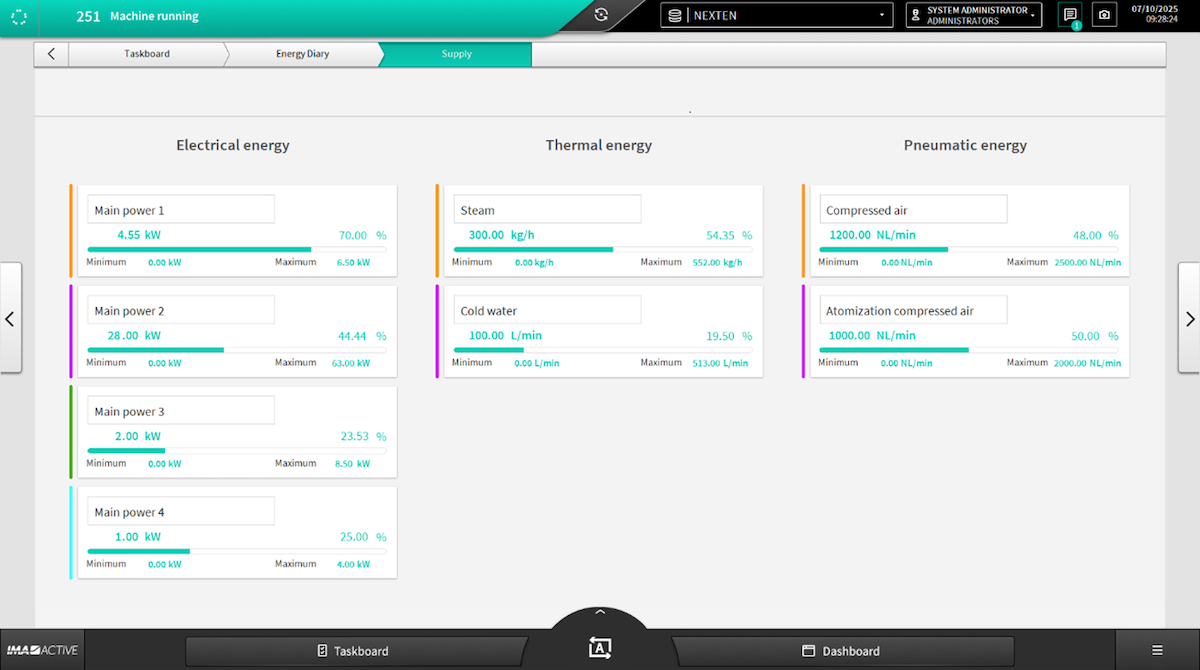
Using the side arrows, access is obtained to the details of individual utilities: electricity, heating, pneumatic supplies. For each category, users can choose to view current data or select data for a specific period or batch using the appropriate filter. Once the data have been selected, they will be displayed as a trend view graph.
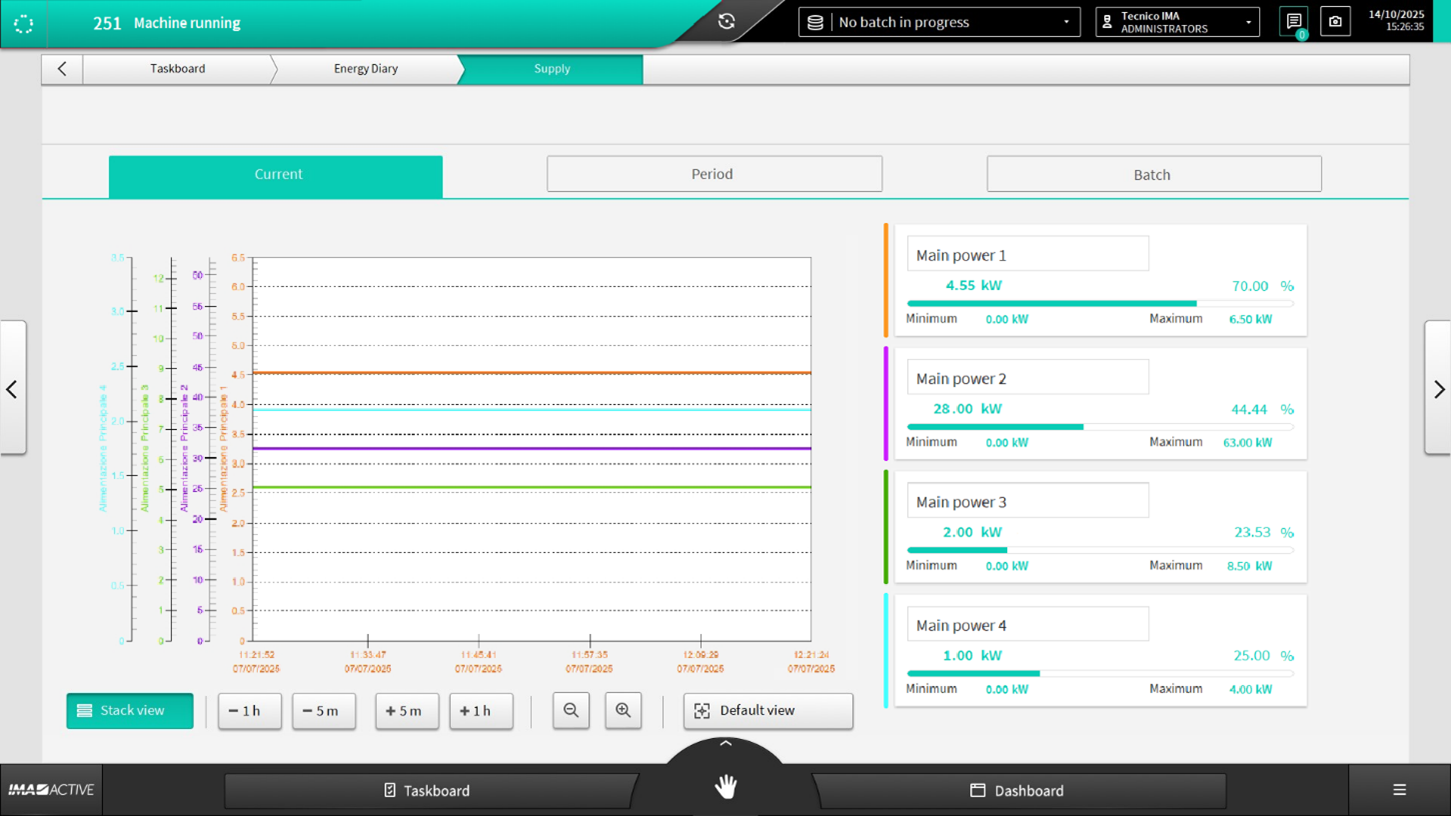
The advanced level allows for a more granular-level monitoring of the asset's consumption, including a detailed analysis and storage of the operation data of the asset devices.
From the dedicated “Devices” page, the time and batch filters can be used to perform in-depth analyses on the energy behaviour of the individual devices included in the asset via the trend view option.
In addition, the advanced mode guarantees storage and displaying of data for system components used for purposes other than the conversion of energy into work - such as rinsing water or nitrogen, which can be found on the "Others" page.
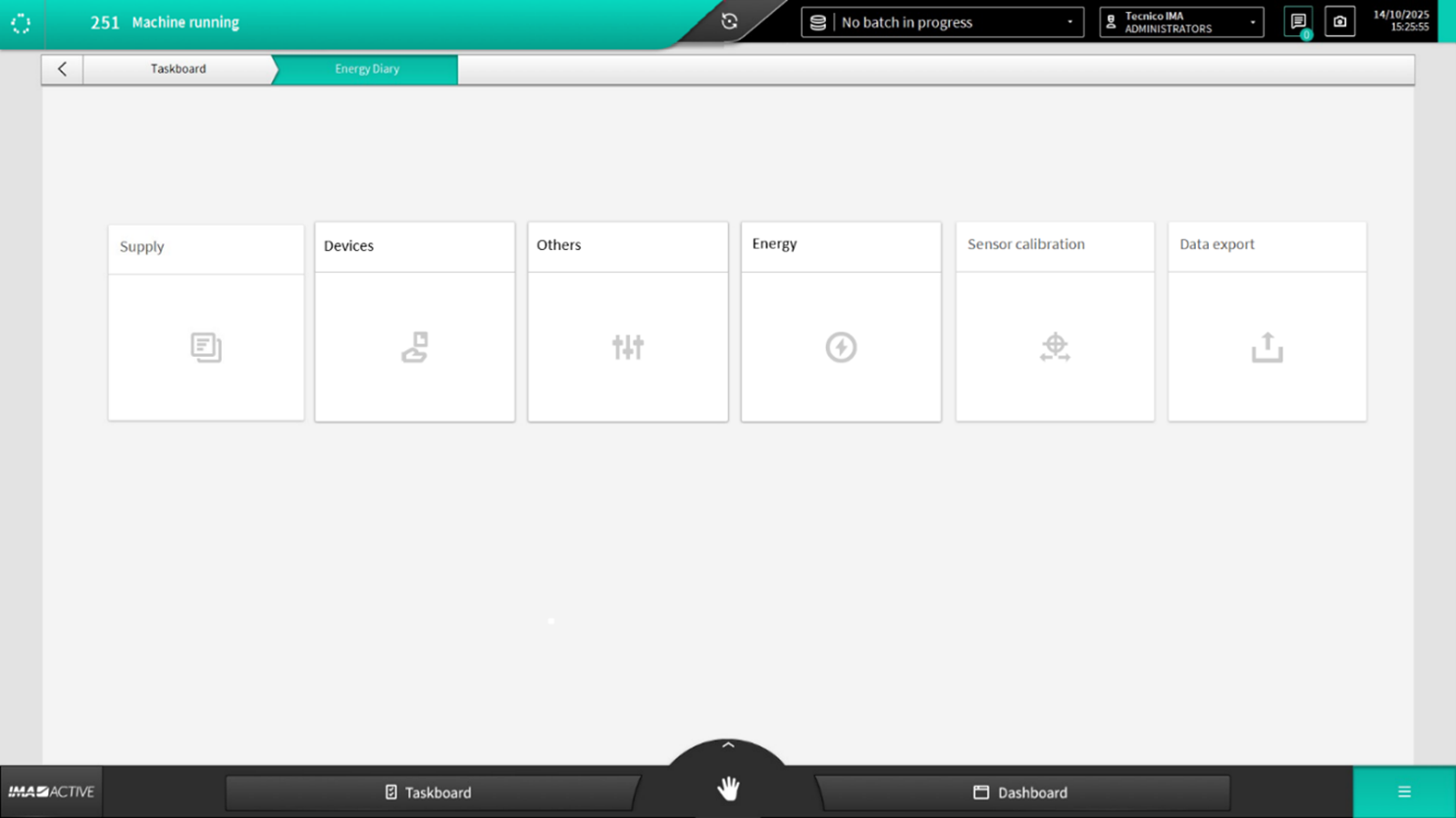
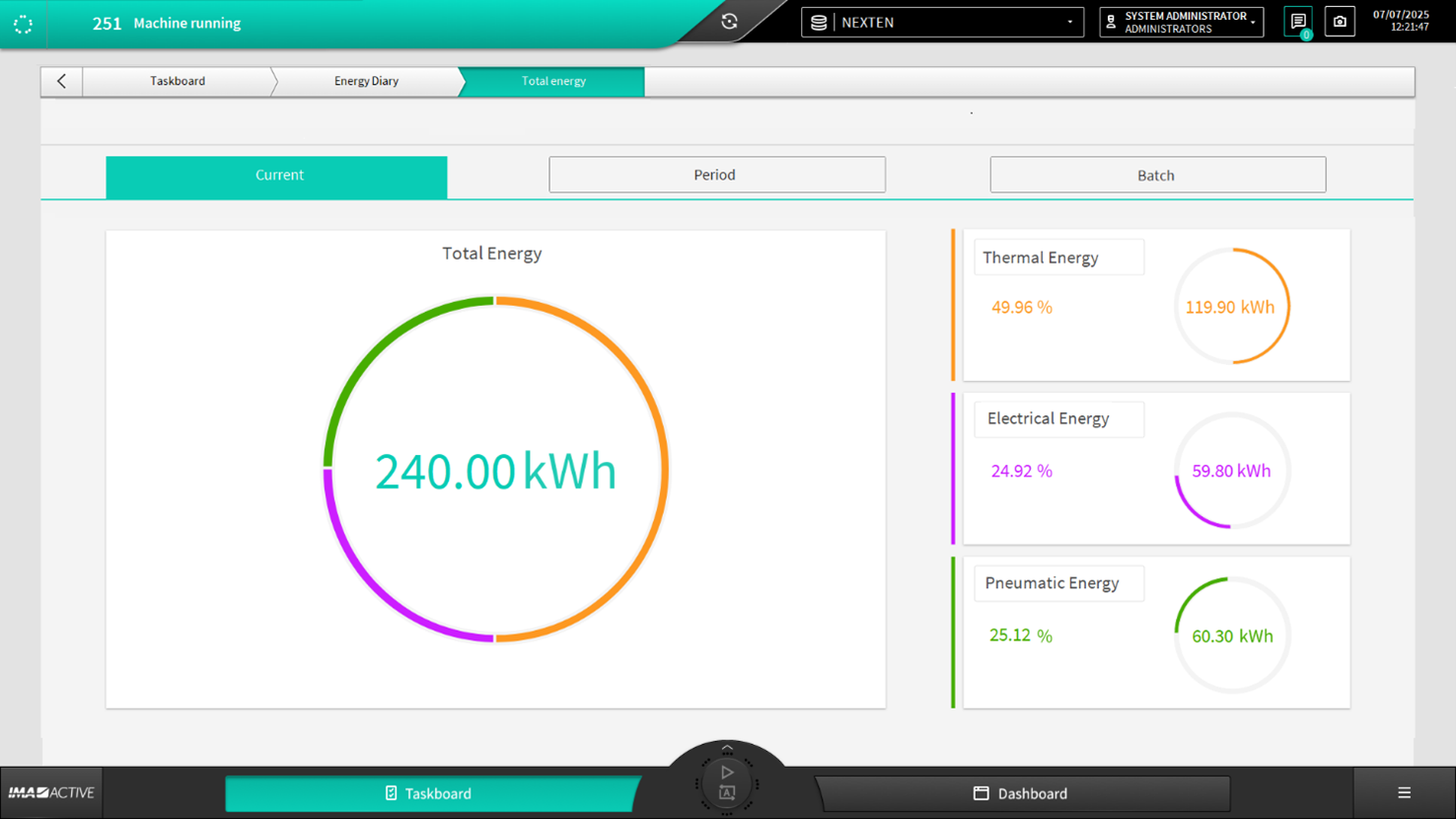
To complement the advanced mode, the “Energy” page is available, which includes a general KPI that can be used for comparative analyses of the machine's energy efficiency performance.
By normalising all energy quantities in kWh, the operator can make energy comparisons over various periods or between different batches.
The platform also allows for calibration of the sensors used for energy monitoring from the dedicated “Sensor Calibration” page, which is always accessible regardless of the Energy Diary level chosen. The proposed linearisation procedure allows sensor reading to be calibrated with respect to a two-point calibration profile - generally corresponding to the start- and end-of-scale values.
The operator must enter two raw measurements captured by the installed sensor and the two corresponding reference values measured by an external instrument. The user can also configure the minimum and maximum value of the sensor reading range. The value resulting from the linearisation function is displayed directly in the application interface.
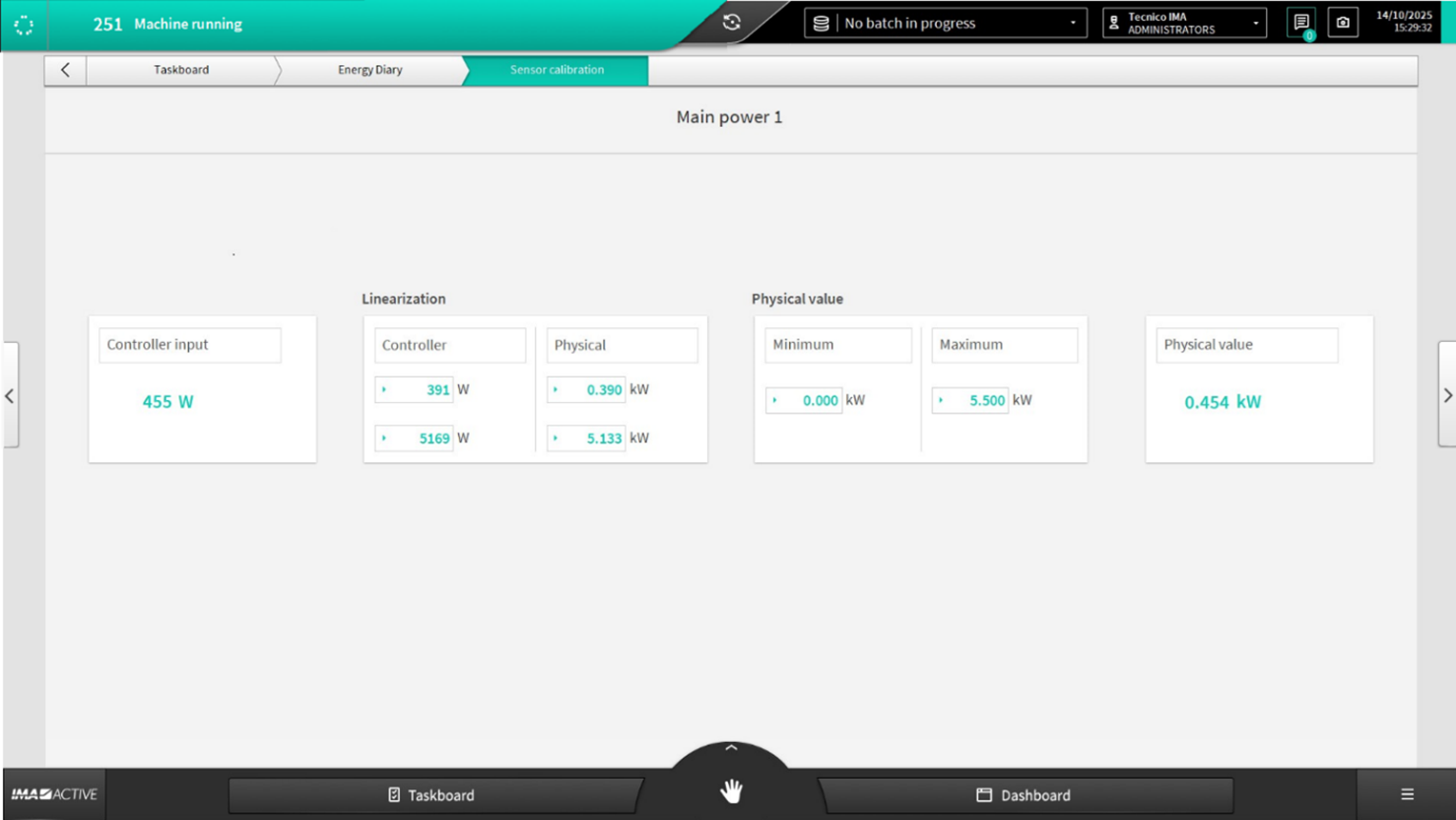
Using the side arrows, the linearisation of each installed energy sensor can be accessed.
Finally, it is possible to perform a mass export of all the energy data collected in a given period or batch in .csv text format.
By accessing the "Data export" page, the user can select, using a specific filter, any required period or batch, generating a report containing all the corresponding supply, device and energy data.
Through solutions such as the Energy Diary, IMA translates its sustainability priorities into practical tools that support more efficient, transparent and responsible industrial operations. By enabling the monitoring, analysis and optimisation of energy consumption, the system helps customers reduce environmental impact, improve operational performance and make informed, data-driven decisions.
As part of IMA’s broader approach to Decarbonising our value chain and Enabling circularity, the Energy Diary demonstrates how machine functionality can actively contribute to lower-impact production models and more conscious resource use. In doing so, it supports customers in addressing evolving regulatory requirements, market expectations and climate-related challenges.
Through solutions like the Energy Diary, IMA goes beyond supplying technology. We act as Sustainability Enablers, supporting our customers in achieving their climate and efficiency goals while helping shape a more resilient, responsible and future-ready manufacturing ecosystem.