







In modern pharmaceutical manufacturing, particularly in the production of Oral Solid Dosage (OSD) forms, powder blending represents a critical unit operation. Blend homogeneity directly impacts critical quality attributes (CQAs) such as content uniformity, dose accuracy, and ultimately patient safety. At the same time, blending is traditionally associated with significant process time, repeated off-line quality control (QC) testing, and material consumption for sample withdrawal and destructive analysis. These aspects translate into increased energy usage, material waste, and operational inefficiencies.
The integration of Near-Infrared (NIR) spectroscopy as an in-line Process Analytical Technology (PAT) within powder blending operations fundamentally changes this paradigm. By enabling real-time, non-destructive, and continuous monitoring of blend homogeneity, NIR-based systems support a scientific, data-rich approach to process understanding and control, aligned with Quality by Design (QbD) and regulatory expectations.
In particular, this approach is fully consistent with the principles outlined in ICH Q8 (Pharmaceutical Development), ICH Q9 (Quality Risk Management), and ICH Q10 (Pharmaceutical Quality System), as well as the FDA Guidance on PAT. These frameworks explicitly encourage enhanced process understanding, real-time monitoring, and life-cycle process verification as mechanisms to ensure product quality while improving manufacturing efficiency.
Beyond quality and compliance, the adoption of NIR-based in-line monitoring delivers measurable sustainability benefits through reductions in processing time, energy consumption, downstream QC activities, solvent usage, and material waste. These benefits directly contribute to corporate Environmental, Social, and Governance (ESG) objectives by supporting energy efficiency, waste minimisation, and responsible resource utilization within GMP manufacturing environments.
IMA approach
The use of an in-line MicroNIR spectrometer in IMA blenders demonstrates how the use of NIR spectroscopy in pharmaceutical powder blending enhances process sustainability through process time optimisation, energy efficiency, and reduction of analytical and material burdens.
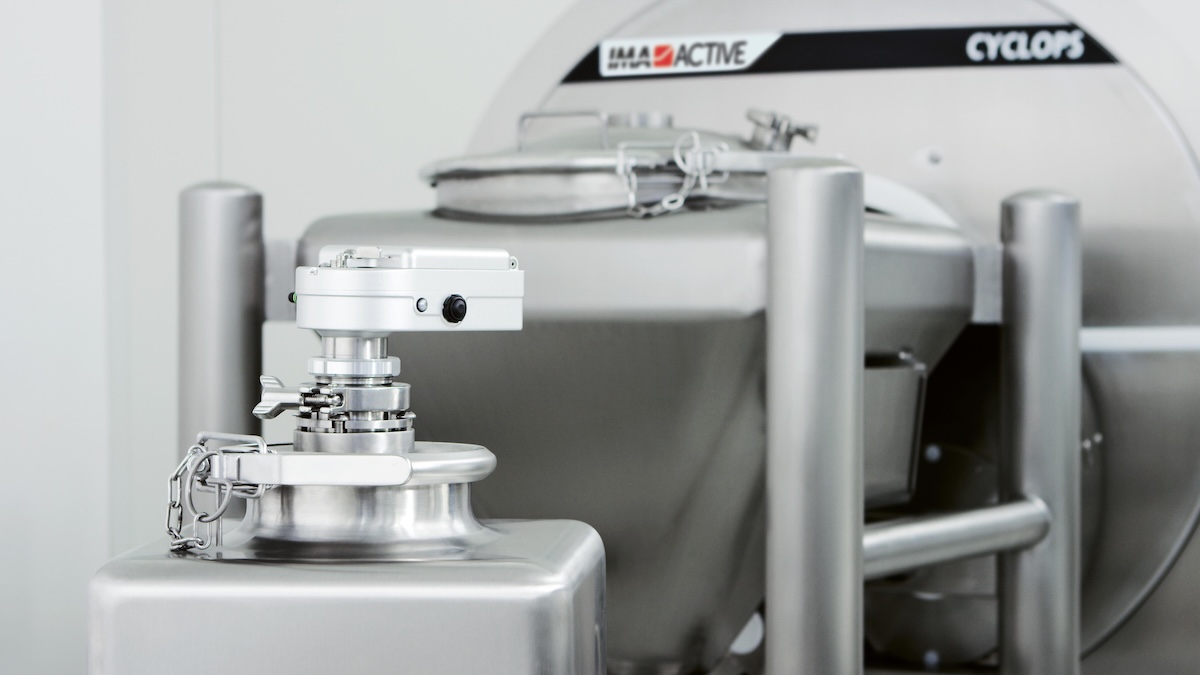
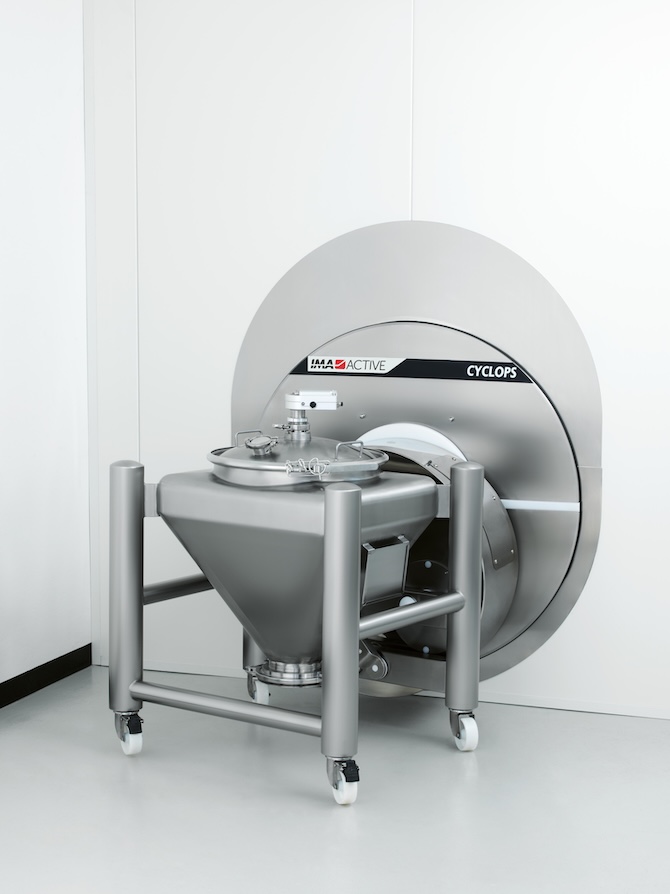
When implemented in-line on a tumble blender, such as the CYCLOPS LAB system, the MicroNIR sensor continuously acquires spectral data throughout the entire blending operation.
This small device is clamped on the bin lid through a tailored sight-glass flange, enabling uninterrupted acquisition under real operational conditions. This configuration is inherently non-invasive and does not introduce any mechanical or thermal perturbation to the system.
A key mechanism by which in-line NIR monitoring enables tangible reduction of blending time is the application of chemometric analysis based on the Moving Block Standard Deviation (MBSD) of the acquired spectral data. Unlike conventional end-point determination methods, which rely on fixed processing times or off-line sampling, MBSD provides a statistically robust indicator of blend homogeneity derived directly from in-process spectral variability. From a mathematical standpoint, MBSD quantifies the local standard deviation of NIR spectra with respect to blending time. During the early stages of blending, high MBSD values are typically observed due to heterogeneous distribution of formulation components and pronounced spectral variability. As mixing progresses, particle redistribution and improved component dispersion lead to a progressive reduction in spectral variability, which is reflected by a decreasing MBSD trend, as clearly visible in the experimental graphs reported below.
The critical advantage of MBSD analysis lies in its ability to identify, in real time, the transition from an active mixing regime to a steady-state homogeneous condition. When the MBSD profile reaches a stable minimum or plateau, further blending does not produce any statistically significant improvements in homogeneity. At this point, continued operation of the blender represents overprocessing, contributing only to additional energy consumption, mechanical stress, systematic overmixing and even potential demixing.
Moreover, through MBSD analysis, minor behavioral differences among similar formulations can be detected and the process can be optimised accordingly. Graph 1 shows the experimental data of blending processes obtained with two formulations differing only in the PSD of microcrystalline cellulose.
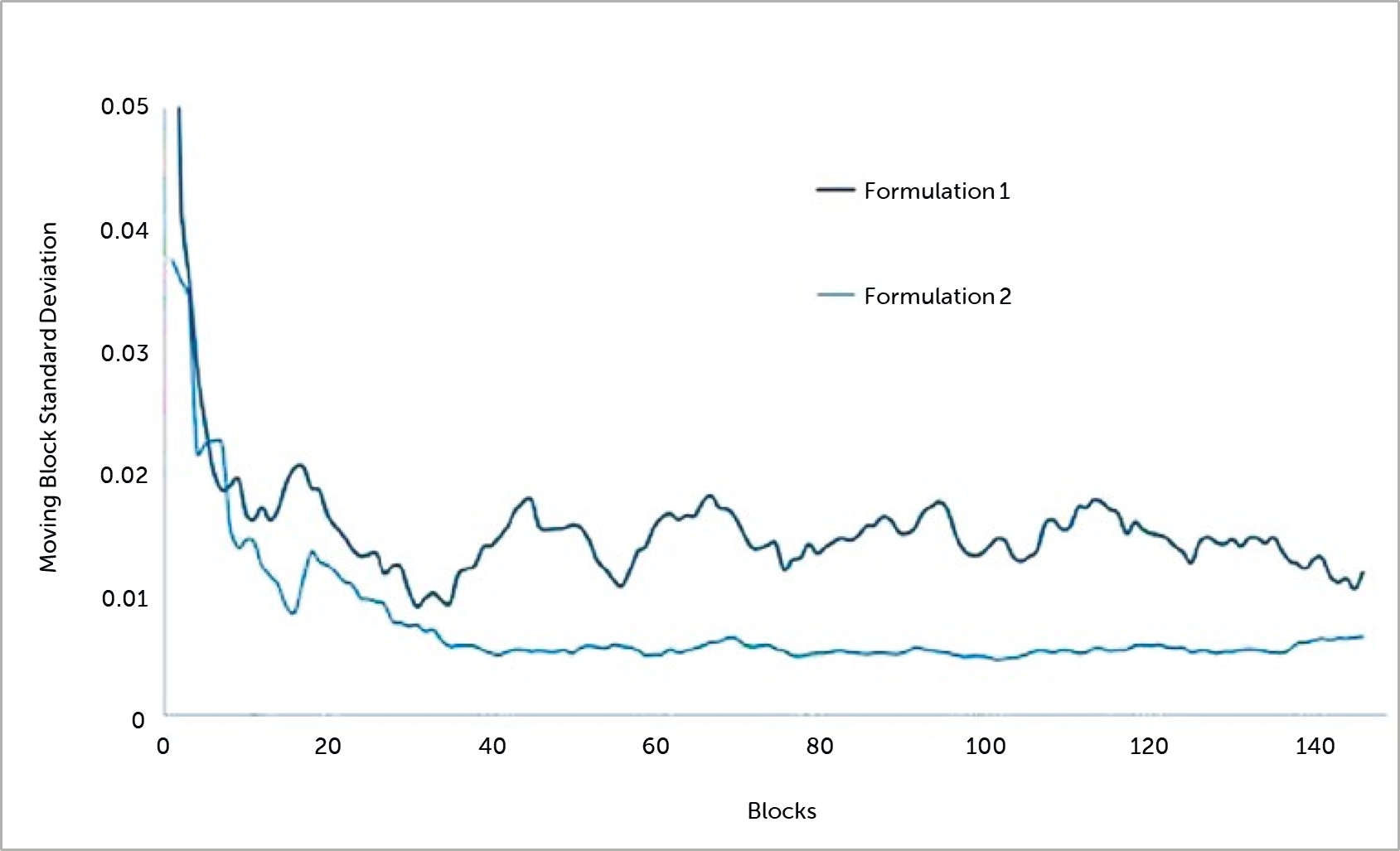
Graph 1: MBSD profiles obtained on CYCLOPS LAB under identical blending conditions: bin filling 75%. Formulation 1 and Formulation 2 are blends containing microcrystalline cellulose PH101 and PH102 respectively.
These similar blends exhibit distinct MBSD decay kinetics under identical process conditions demonstrating that a fixed blending time would inevitably overprocess at least one of the two formulations, whereas MBSD-based monitoring enables formulation-specific endpoint determination.
Similarly, Graph 2 highlights how MBSD-based monitoring allows the best equipment set-up for each formulation.
By enabling objective, data-driven identification of the MBSD plateau, chemometric analysis allows batch-specific and formulation-specific determination of the true blending endpoint. This approach replaces conservative, worst-case mixing times with scientifically justified, real-time decisions, fully aligned with PAT and Quality by Design principles.
Sustainability pillars
Blending equipment energy consumption is directly proportional to operating time and mechanical load. By reducing blending time through real-time MBSD endpoint detection, NIR implementation leads to lower electrical energy demand per batch; reduced mechanical wear on motors, bearings, and drive systems; and decreased heat generation, with secondary benefits on HVAC requirements in GMP areas. In high-frequency batch or Continuous Manufacturing environments, even single-digit percentage reductions in blending duration can lead to substantial annual energy savings and associated reductions in CO₂ emissions. These cumulative benefits significantly strengthen the justification for NIR-based PAT implementation from both an economic and environmental sustainability perspective. Moreover, conventional assessment of blend uniformity relies on off-line sampling followed by wet chemistry analysis, typically high-performance liquid chromatography (HPLC). This approach requires: physical sampling of the blend (often multiple locations); sample preparation using solvents and consumables; destructive analysis and waste disposal; significant analyst time and laboratory energy use.
In contrast, in-line NIR monitoring provides a continuous, batch-representative assessment of homogeneity without removing material from the process.
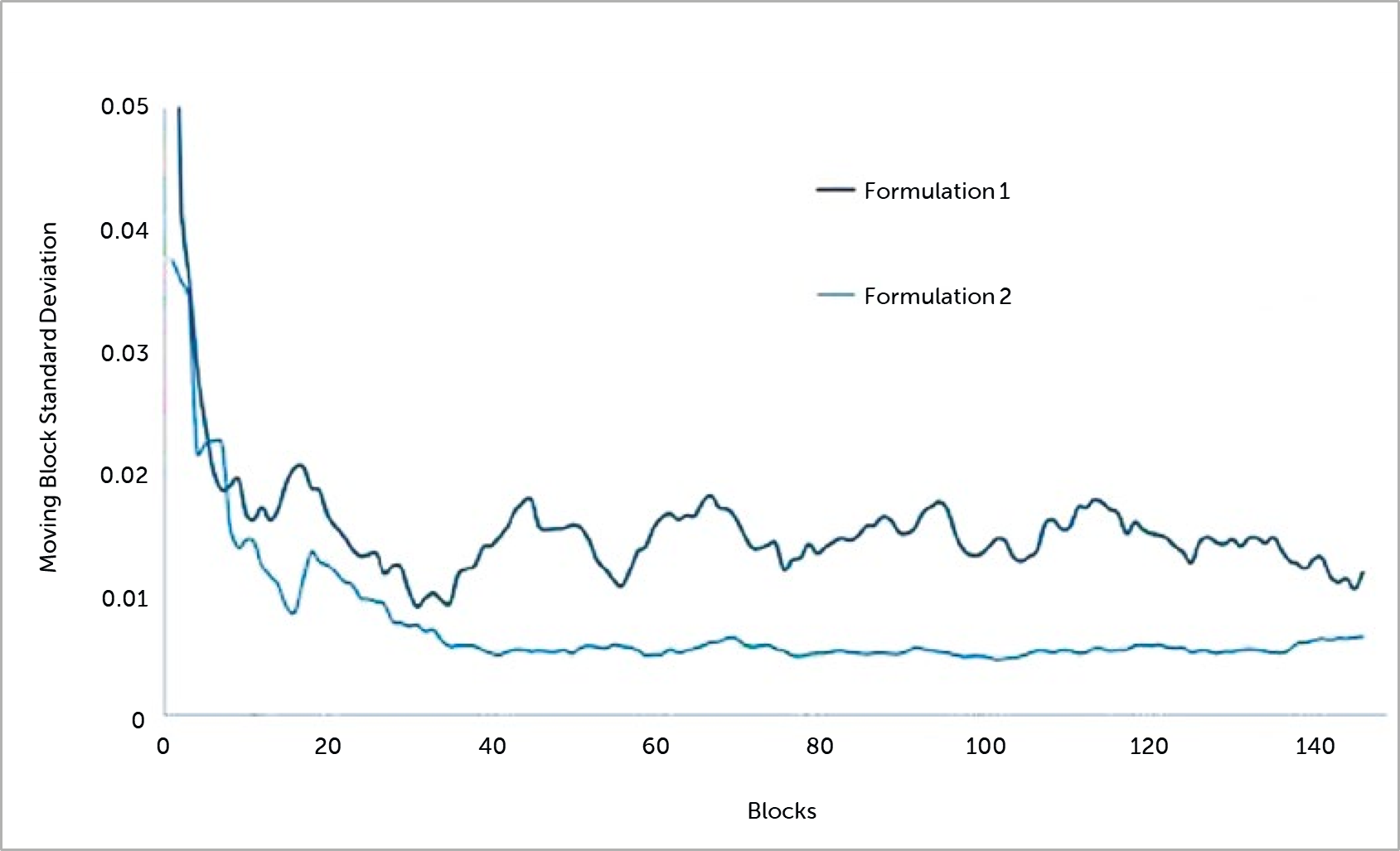
Graph 2: MBSD profiles obtained on CYCLOPS by varying the bin filling level and the rpm for both Formulation 1 and Formulation 2.
This contributes to sustainability through lower consumption of solvents and reagents used in wet chemistry; reduced use of vials, filters, columns, and disposable laboratory plastics; elimination of blend material wasted for analytical purposes. Furthermore, as NIR analysis is non-destructive, 100% of the batch remains available for downstream processing, improving overall material yield. From an operational perspective, reduced reliance on off-line QC shortens release times and minimises work-in-progress inventory. This has indirect sustainability benefits by: reducing storage requirements and associated energy use; improving manufacturing scheduling and equipment utilisation; lowering the probability of batch rework or rejection due to late detection of blend non-uniformity. Beyond direct time and energy savings, NIR-based blending control enhances overall process robustness. Continuous monitoring allows early detection of atypical blending behavior caused by raw material variability or equipment deviations. Corrective actions can be taken before non-conforming material proceeds further in the process chain. By preventing failures (out-of-specification product), NIR-supported blending aligns strongly with the principles of sustainable manufacturing.
Conclusions
The integration of NIR spectroscopy into pharmaceutical powder blending processes provides clear and scientifically substantiated sustainability benefits. Real-time, in-line monitoring enables accurate determination of blending endpoints, leading to reduced process time and lower energy consumption. Simultaneously, the shift from off-line to in-process quality assessment minimises the need for destructive testing, cutting down on analytical materials, solvents, and waste. The experimental evidence from the CYCLOPS blending case study demonstrates that NIR-based MBSD analysis reliably captures blending dynamics and correlates with traditional quality metrics. By embedding this capability into routine production, manufacturers can achieve a more efficient, robust, and environmentally responsible process without compromising product quality or regulatory compliance. In the context of increasing regulatory emphasis on PAT, QbD, and sustainable manufacturing, NIR-enabled blending represents a mature and high-impact technological solution that directly supports both operational excellence and long-term sustainability goals.